Checked
Salamoia Gelateria Naturale
Montepulciano
Montepulciano gelateria bringing a staffed vintage or modern cart with up to six flavours to weddings and events.
Montepulciano is a long, steep Renaissance town on a ridge between the Val d'Orcia and the Valdichiana, and the home of Vino Nobile. It offers one of the widest ranges of ceremony settings of any comune we looked at — and publishes the price of exactly none of them.
Sources checked 14 September 2026
The Bravìo delle Botti is the town's own festival, in which the contrade race barrels uphill through the streets. The race itself falls on the final Sunday, but the comune's programme runs for about ten days across late August — in 2025, from 22 to 31 August — with historical processions, flag-throwers and drummers, tastings and the contrade open through the period.
For a wedding, this means the last third of August is committed. The streets are in use, accommodation is taken, and the town's attention is on the race. Combined with Ferragosto on 15 August, when much of Italy closes, August in Montepulciano is a month to approach carefully.
The rest of the year it is a quiet town.
The comune describes an unusually varied set of places where it will celebrate a civil marriage: the town hall cloister, municipal rooms, the Civic Museum, the Fortress gardens, the Teatro Poliziano, and natural areas near Lake Montepulciano.
That is a wider choice than most Tuscan comuni offer — a theatre and a lakeside are not usual options. But the comune states only that its staff can provide information "on the tariff set for the use of spaces", and publishes no figures.
So Montepulciano joins Siena and Montalcino as one of three comuni we checked where the price arrives by email rather than on the website. Ask early, and ask for the tariff, the available dates and the permitted settings in the same message. By way of scale, published fees elsewhere in Tuscany run from €100 in Cortona to €5,100 in Florence — see our cost guide.
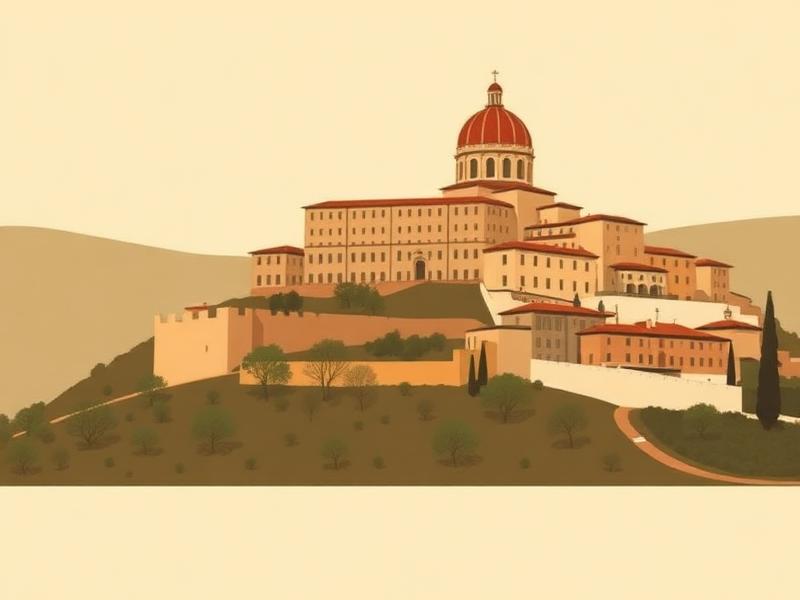
Montepulciano runs along the top of a long hill, and its main street climbs most of the way. The walk from the lower gate to Piazza Grande at the top is a genuine ascent, on stone, and it is the thing guests remember.
Plan around it rather than through it. Keep the ceremony and the reception at the same level or arrange transport between them, tell guests to bring shoes they can walk in, and think about anyone in your party who will struggle with a long climb in heat.
The compensation is the view from the top, which takes in both valleys.
Like Montalcino to the west, this is a serious wine town, and many of the properties that host weddings are working estates with cellars beneath the town itself.
The same caution applies: late September and early October are harvest, when the estate is busy with the work that pays for it. Ask what harvest means for your day — access to the cellars, who is working, which spaces are in use — rather than assuming the property will be as you saw it in May.
Montepulciano is in southern Tuscany, well beyond Siena, and the transfer from either Florence or Pisa is long. Rome is a realistic alternative for some guests.
The last leg is a drive through hill country, and accommodation is limited in the way it is everywhere in this part of Tuscany — small towns, no hotel stock to absorb a large party. Check beds before the venue and before the date.
As in every Tuscan historic centre, vehicle access is restricted, and here the geography makes it more consequential: parking is below, and the town is above.
The comune's settings, which are the most varied of any comune we checked — cloister, museum, fortress gardens, theatre, lakeside.
Wine estates in the surrounding countryside, many with historic cellars.
Historic residences in the town, generally small and suited to dinners.
Agriturismi in the Valdichiana below, usually the most affordable and with the most parking.
The venues guide covers what to ask, and the Val d'Orcia page covers the protected landscape immediately to the west.
The figures, rules and deadlines on this page come from these — comuni, regional bodies and official registers, not other wedding sites. Rules change; confirm anything you are about to act on.
1 listed here. Most planners, photographers and caterers work across the whole region — browse every Tuscany vendor.
Photography on this page is illustrative and does not depict the individual business or venue listed.
Tuscany is not one place, and the eleven areas couples usually choose between suit genuinely different weddings. This page is a way of deciding rather than a ranking: the four questions that actually separate the areas, and what each one means for the day you are planning. The detail for each area lives on its own page.
Read guideAlmost every figure you will read about Tuscany wedding costs is someone's estimate presented as a fact. This page takes a different approach. It sets out the costs that are genuinely published — town hall fees, stamp duties, consular charges, all of them sourced and linked — and then explains, without inventing numbers, how the quotes for everything else are built and what moves them. It is less tidy than a price list. It is also true.
Read guideMost of the paperwork for an Italian wedding comes down to one question: can the registrar see proof that nothing in your own country's law prevents you from marrying? That proof is called a nulla osta, and where you get it depends entirely on which passport you hold. This page sets out the steps in the order you will meet them, and says clearly where the answer depends on your own embassy and the particular town hall.
Read guideMost wedding checklists are built around a generic timeline. This one is built around the deadlines that actually exist in Italy — the notice periods comuni publish, the expiry dates on consular documents, and the handful of things that can only be done in person. Where a date is fixed by an authority, it is sourced. Where it is judgement, it says so.
Read guideDiscover venues, vendors and guides made for couples planning from abroad.
Start planning your wedding